



Dental Implants
Dental Implants Presentation
To provide you with a better understanding of dental implants, we have provided the following multimedia presentation. Many common questions pertaining to dental implants are discussed.
Dental implants are a permanent solution for anyone missing one or more teeth that provide fit, function, and a beautiful smile that cannot be found with dentures, bridges, or other tooth replacement options.
What are Dental Implants?
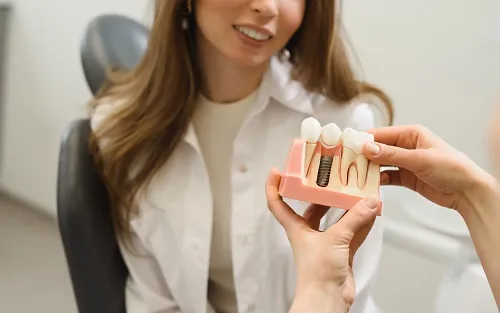
Dental implants are permanent replacements for missing teeth that are made of three sections:
THE IMPLANT: The implant is surgically placed in the jawbone to replace the root of a missing natural tooth. It is usually made of titanium or ceramic for those allergic to metal. The implant slowly fuses with the surrounding bone, creating a stable foundation to support an artificial tooth.
THE ABUTMENT: The abutment is a slender pin or fastener that attaches the implant to a dental restoration, replacing the visible portion of the missing tooth.
THE RESTORATION: The restoration is a dental prosthetic that replaces the visible, functional part of the missing tooth. If a single tooth is replaced, the restoration is a dental crown. However, when multiple teeth are missing, the restoration can be a permanent bridge or denture that attaches permanently to multiple implants
Your Trusted Oral Surgeons in Marietta, Woodstock, Dallas, & Acworth
Accepting new patients. Schedule Your Appointment today!
770-672-5629 Request An Appointment
Who Performs the Dental Implant Placements?
Implants are a team effort between our highly skilled oral and maxillofacial surgeons at Northwest Oral and Maxillofacial Surgery Associates and a Restorative Dentist. Our surgeons perform the actual implant surgery, initial tooth extractions, and bone grafting, if necessary, while your dentist fits and makes the permanent prosthesis. Your dentist will also make any temporary prosthesis needed during the implant process.
Although some dentists perform implant placement surgery, they do not regularly perform oral surgery and are often not familiar with the latest techniques. Our oral surgeons are uniquely qualified to place dental implants due to their advanced training in surgical techniques, anatomy, and complex case management.
Surgical Advances
Using the most recent advances in dental implant technology, our doctors are able to place single stage implants. These implants do not require a second procedure to uncover them, but do require a minimum of six weeks of healing time before artificial teeth are placed. There are even situations where the implants can be placed at the same time as a tooth extraction – further minimizing the number of surgical procedures. Advances in dental implant technology have made it possible, in select cases, to extract teeth and place implants with crowns at one visit. This procedure, called immediate loading, greatly simplifies the surgical process.
What are the Benefits of Dental Implants?
The benefits of dental implants are undeniable. If you have missing teeth or are unhappy with your dentures or dental bridge, consider the many benefits of implants:
 A BEAUTIFUL SMILE: Our patients are thrilled with the way they look after getting dental implants. After their dentist attaches their replacement teeth, our patients are often surprised by how much they have missed smiling and how much better their facial features look.
BETTER BONE HEALTH: Losing teeth leads to losing bone mass in the jawbone, which shrinks the jawbone. This leads to the aged, sunken appearance that is common when people have missing teeth. Dental implants preserve jawbone health and stimulate bone growth for strength and stability.
PROTECTING DENTAL HEALTH: Dental implants protect patients from additional tooth loss. When one or more teeth are replaced with implants, the implant’s presence in the tooth socket stabilizes any remaining teeth. Otherwise, the remaining teeth would shift and collapse toward the gap in the jawbone, leading to misalignment.
BETTER NUTRITION: Dental implants restore your ability to eat a healthy diet, particularly meats and raw fruits and vegetables. No other type of tooth replacement allows you to eat crunchy, hard, or tough foods with your full bite force.
EASY CARE: Dental implants require no special care. Once you have healed from implant surgery, you brush and floss your restorations like natural teeth and see your dentist twice yearly for professional dental cleaning and checkups. There is no need for denture adhesives, special cleaners, or removing your artificial teeth at night.
COMFORT: Trying to eat with missing teeth can lead to sores on the gums and is difficult. Dentures and bridges slip, shift, and pinch. Only dental implants are so stable that they feel and perform like your natural teeth. You will never have to worry about sore spots, pinching, embarrassing slippage, or foregoing your favorite foods with dental implants.
PERMANENT: Implants are designed to last decades, providing a long-term solution to missing teeth. Most patients’ implants last a lifetime, with their restorations lasting 30 years or more. This longevity far surpasses that of dentures, which must be replaced every 5-10 years and often need repairs or relining.
Who Is a Good Candidate for Dental Implants?
You are a good candidate for implants if you are in good health and have sufficient jawbone to support dental implants. If your jawbone has deteriorated, you may still qualify but have to undergo bone grafting surgery first.
Individuals with certain autoimmune diseases, blood clotting disorders such as hemophilia, or uncontrolled diabetes may not be candidates for dental implants. These conditions can affect the body’s ability to heal and may increase the risk of implant failure. If you are a heavy smoker, implant failure is also a serious risk. A consultation with one of our oral surgeons is the best way to determine whether you are a candidate for dental implants.
What Types of Prostheses are Available?
A single prosthesis (crown) replaces one missing tooth, and each prosthetic tooth attaches to its own implant. A partial prosthesis (fixed bridge) can replace two or more teeth and may require only two or three implants. A complete dental prosthesis (fixed bridge) replaces all your upper or lower jaw teeth. The number of implants varies depending upon which type of complete prosthesis (removable or fixed) is recommended. A removable prosthesis (over denture) attaches to a bar or ball in socket attachments, whereas a fixed prosthesis is permanent and removable only by the dentist.
Our doctors perform in-office implant surgery in a hospital-style operating suite, thus optimizing sterility. Inpatient hospital implant surgery is for patients with special medical or anesthetic needs or for those needing extensive bone grafting from the jaw, hip, or tibia. Northwest Oral and Maxillofacial Surgery Associates maintains privileges at local hospitals for its different locations for these types of procedures.
If you have been referred to our office for dental implant surgery, your dentist is confident that our oral surgeons will perform your implant placement skillfully and precisely. During your consultation, our team will assess your oral health, discuss your treatment options, and answer any questions you may have. We collaborate closely with many local dentists and prosthodontists for exceptional results. Please get in touch with our office to schedule a consultation to discuss your dental implant treatment plan.
Dental Implants FAQ
How much do dental implants cost?
The cost of dental implants depends on several factors, including the type of implant used, the location of the implants, the type of sedation used, and how many implants are needed. The cost of the restorations is also a consideration. At Northwest Oral & Maxillofacial Surgery Associates, we use only the highest quality materials to ensure your implants last a lifetime. To get an accurate quote for dental implants, please schedule an appointment for an initial consultation with one of our oral surgeons. The lifelong results and pleasure of a restored smile are well worth the initial investment.
Why should I see an oral surgeon for dental implants?
Unlike general dentists, our oral surgeons have completed additional years of education focused specifically on surgical procedures so that they can handle challenging cases involving significant bone loss or delicate facial structures. We are skilled at optimizing implant placement for long-term stability and aesthetics while minimizing potential complications.
What is the success rate of dental implants?
Dental implants have an impressive success rate of over 96% in patients who follow their aftercare guidelines and maintain good oral hygiene.
Am I too old for dental implants?
No! Dental implants can benefit patients of any age. Many individuals in their 80s have rediscovered their enjoyment of food and socializing after getting them.
770-672-5629 Request An Appointment Your Trusted Oral Surgeons in Marietta, Woodstock, Dallas, & Acworth
Accepting new patients. Schedule Your Appointment today!